
When Promissory Technologies Run Out of Road: Turning the Heat Up on the UK’s Incineration of Wood Biomass
Dr Nick Hacking
6/13/20269 min read
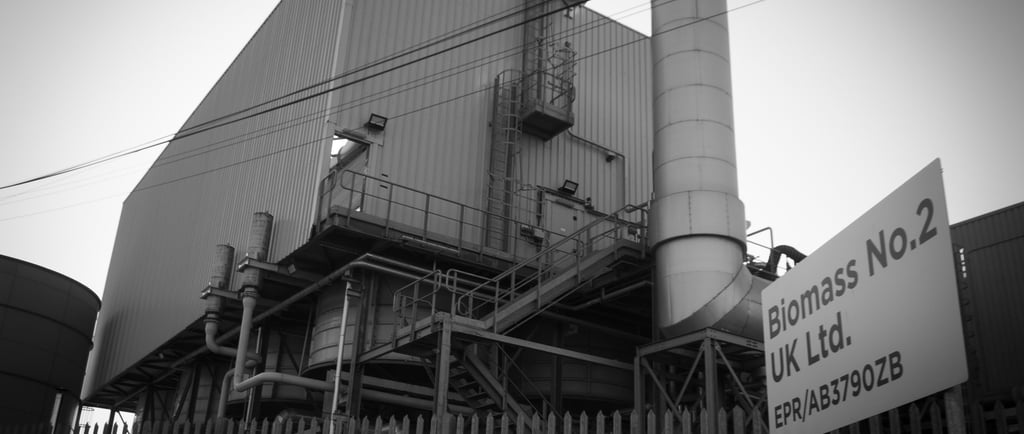
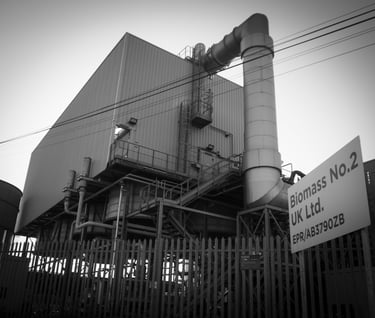
Something quietly significant happened on the waterfront at Barry Docks in late 2024. The buildings of the Barry Biomass No. 2 facility - a wood-gasification plant backed by Aviva Investors, opened amid controversy, plagued by planning disputes, and never fully operational - were handed back to Associated British Ports (ABP) after the operating company went into liquidation. By late 2025, ABP had submitted a prior notification of demolition. The writing was not merely on the wall: the demolition crews were on their way.
Several hundred miles to the north, a rather larger biomass operation continues to burn on in Yorkshire. Drax Power Station at Selby, the self-proclaimed flagship of British renewable energy and the country’s single largest emitter of CO₂, has spent the better part of two decades promising that its future lies not in burning imported wood pellets, but in capturing and storing the carbon those pellets release. The technology is known as Bioenergy with Carbon Capture and Storage, or BECCS. It has not yet been installed. It may never be. And in December 2025, Drax quietly shelved its BECCS subsidiary, cut around one hundred related jobs, and pivoted its corporate strategy towards data centres and battery storage.
Barry and Drax are very different in scale. But they share a structural logic that the sociologist of science and technology Mads Borup and colleagues identified in a landmark 2006 paper as the ‘sociology of expectations’ (Borup et al, 2006). In that framework, technologies do not simply emerge from laboratories and enter markets. They are performed into being through promises - what Borup et al. describe as ‘wishful enactments of a desired future’ (p.286) - which mobilise investors, policymakers, and planning consents long before any technical reality has been demonstrated. The promise, crucially, does its work regardless of whether it is ever fulfilled. This blog argues that the story of UK wood biomass energy is, at its core, a story about what happens when promissory technologies meet the hard floor of economic and physical reality. What we see is that the promise does its work regardless of whether it is ever fulfilled. In terms of biomass energy, that work appears to have been very profitable - at least for some.
The Architecture of a Promise
Drax’s reinvention as a renewable energy company began in earnest in the mid-2000s when it committed to converting its six generating units from coal to compressed wood pellets. The green credentials of this move depended almost entirely on a single accounting convention: that biomass combustion is carbon neutral at the point of emission, with any CO₂ released attributed instead to the land-use sector. Under the EU Emissions Trading System - and now the UK ETS - biomass plants therefore pay nothing for their carbon emissions, unlike coal and gas generators.
This accounting fiction unlocked a subsidy cascade. Drax currently operates under two overlapping support mechanisms: Renewables Obligation Certificates (ROCs), which support three of its four biomass units, and a Contract for Difference (CfD), which supports the fourth. From April 2013 to late 2023, Drax was issued ROCs worth approximately £4.45 billion. CfD payments added a further £1.38 billion from December 2016 onwards. The CfD guarantees Drax a strike price of £132 per megawatt hour (MWh) for the electricity it generates - more expensive than onshore wind, solar, and many offshore wind contracts (Turver, 2024). Ember, the energy think tank, calculates that by 2027, when the current subsidy regime expires, Drax will have collected over £11 billion in public support (Ember, 2005a, 2005b). All to burn trees.
The deeper promise - the one that kept the subsidy pipeline flowing through years of parliamentary scrutiny and BBC Panorama investigations (e.g. Crowley and Robinson, 2022) - was always BECCS. Once carbon capture was fitted, Drax’s promoters argued, the power station would not merely be carbon neutral but carbon negative: a net extractor of CO₂ from the atmosphere. This is the architecture of a Borupian promise at its most ambitious. The broader, encompassing commitment to BECCS provided what Borup et al. (2006) call a ‘protected space’ or ‘niche’ in which more specific and uncomfortable questions about the present could be deferred. Why worry about the carbon in today’s wood pellet supply chain when the technology of tomorrow will make it all good?
Barry: A Smaller Promise, a Faster Failure
The Barry Biomass No. 2 facility tells a more compressed version of the same story. Backed by Aviva Investors and located in Barry Docks in the Vale of Glamorgan, the plant was a wood-gasification facility with an annual capacity of 86,000 tonnes. It was first granted planning permission in 2010, began construction in 2016, and received an environmental permit from Natural Resources Wales in 2018. It was never properly operational.
Almost from the outset the plant was dogged by a planning enforcement notice issued in 2021 by Vale of Glamorgan Council, which found that the as-built facility contained significant discrepancies from the approved plans: an external conveyor, machine housing, a water tank, and a substation, none of which had received consent. Community opposition was fierce and sustained. In late 2024, the operating company was placed into liquidation, the site handed back to ABP, and in October 2025 ABP submitted a prior notification of demolition to the Vale Council, with completion targeted by spring 2026.
Aviva had also, in late 2024, written off £368 million connected to its closure of the Barry facility and two energy-from-waste plants in Hull and Boston. For the energy-from-biomass (EfB) sector, this was a significant signal. For biomass specifically, it demonstrated that the economic fragility of these plants - which Barry Biomass No.2 plant shared with the broader EfB sector - is not merely an operational risk but a strategic one.
Borup et al. (2006) note that “past failures are often isolated as special or peculiar cases with little technically or organizationally in common with the newly proposed promissory solution.” (p.290) The defenders of biomass energy will no doubt characterise Barry as an unfortunate anomaly: a small, poorly managed plant, nothing like the world-class operation at Selby. But the structural resemblance is uncomfortable. Both facilities promised a technological future that diverged from operational reality. Both relied on public subsidy and supportive planning policy to remain viable. Both eventually encountered the limits of that support. If Barry is the canary, Drax is the coalmine - or rather, the wood-pellet mine.
The Writing on the Wall for Drax
The trajectory for Drax has shifted decisively. In February 2025, the UK government announced that Drax’s biomass subsidies would be cut by roughly half after April 2027, with a new CfD arrangement covering all four units through to March 2031, but at significantly reduced rates. Ember estimates that under this new scheme, Drax’s generation will fall to around half current levels, contributing less than two per cent of the UK’s forecast electricity supply in 2030 (Ember, 2025b).
The BECCS promise has, in parallel, quietly collapsed. Ember’s analysis, published in November 2025, found that a single BECCS carbon removal project at Drax - one project, on one site - could cost £30 billion in subsidies: more than the entire UK government budget allocated for carbon capture, use and storage. By December 2025, Drax had made its corporate position unmistakable: it announced cuts to around one hundred roles in its BECCS subsidiary, dropped any mention of BECCS from its trading update, and confirmed its strategic pivot to data centres, battery storage, pumped hydro, and gas-fired balancing assets. A partner carbon capture firm backed by Drax and BP had already laid off most of its staff in March 2025.
This appears to be a company repositioning itself for a post-BECCS future while continuing to extract maximum value from its remaining subsidy entitlement. Remove the subsidies tomorrow, and there is no plausible commercial logic for continuing to import wood pellets across the Atlantic - over 99 per cent of Drax’s feedstock is imported from North America - to generate electricity at £132 per MWh. The Lords Secondary Legislation Scrutiny Committee said as much in May 2025, criticising the proposed subsidy arrangements as inadequately scrutinised and financially opaque (SLSC, 2025).
Court papers published in early 2026 added a further dimension of reputational damage, revealing that senior figures within Drax had privately questioned whether the company’s public sustainability claims could be supported, even as those claims were being repeated to regulators and investors (Ambrose, 2026).
Planning, Policy, and the Problem of Promissory Technologies
For planning professionals, the biomass story raises questions that go beyond a single company or site. Under the National Policy Statements for Energy - notably EN-1 and EN-3 - large-scale biomass is classified as low carbon, positioned as a contributor to security of supply, and benefits from a presumption in favour of consent under the Planning Act 2008. The planning system did not create biomass policy: it operationalises it. Therein lies the problem.
Carbon accounting in planning decisions treats biomass emissions as zero at the point of combustion, consistent with the Climate Change Act 2008 conventions. Environmental Impact Assessment therefore tends to downplay direct CO₂ emissions and focus on secondary impacts - traffic, air quality, landscape. Yet in atmospheric terms, Drax remains one of the UK’s largest emitters. The planning system is operating with a formal carbon logic that diverges from physical reality.
There is also a structural gap in what the planning system can assess. Sustainability is treated as a compliance issue - certifiable through approved schemes and greenhouse gas (GHG) thresholds - when it is actually a strategic constraint. UK planning cannot meaningfully interrogate forestry practices in the southern United States or British Columbia, or the cumulative ecological effects of global biomass demand. The impacts that matter most lie outside the spatial and legal reach of the development consent process.
Borup et al.’s (2006) framework helps us understand why this situation has persisted. Promises about future technologies - about BECCS delivering negative emissions by 2030, about biomass being a transition rather than a destination - are not merely rhetorical. They are, in the sociology of expectations framework, performative: they constitute the investment, the planning consent, the subsidy regime, and the policy classification that together make a technology real, or at least real enough to be funded. By the time the promise begins to fray, it is embedded in too many institutional structures to be easily unwound. This is policy inertia with a theoretical name. Promises about BECCS were not merely rhetorical. They were performative - constituting the consents, subsidies and policy classifications that kept biomass burning long after the evidence had turned.
A Technical Fix Running Out of Road
In planning terms, biomass energy exhibits the classic characteristics of a technical fix: a solution that allows continuation of existing practices - here, centralised thermal generation - while deferring harder systemic changes. It relies on accounting mechanisms to resolve carbon impacts rather than reducing them. It externalises key environmental effects beyond the planning boundary. And it avoids confronting more fundamental alternatives: demand reduction, grid transformation, and the deployment of genuinely zero-emission technologies.
The market has begun to reach its own verdict. Investor confidence in EfB outside major subsidised assets is fragile, as Barry demonstrated. Direct Air Capture - the other great promissory carbon removal technology - has also faltered: five UK government-funded pilot projects between 2020 and 2025 achieved an average cost of £28,000 per tonne of CO₂ captured, against a government target of £200 per tonne. The more promising home for carbon capture technology may lie not in power generation at all, but in genuinely hard-to-abate industrial point sources: cement, steel, and chemicals. These are sectors where there is no credible alternative, which is a fundamentally different proposition from a power station that could be replaced by offshore wind (Ember, 2025a).
As Borup et al. (2006) observe, the hype cycle of promissory technologies typically moves through ‘alternating cycles of hype and disappointment’. The hype phase for biomass with CCS is over. The disappointment phase - measured in billions of pounds of sunk subsidy, a demolished plant in Barry Docks, and a corporate U-turn in Selby - is now well underway.
Conclusion: Towards a More Critical Planning Stance
The case against Drax is not that it falls outside planning policy. It is that planning policy itself may be lagging behind the evidence base. The legal, accounting, and policy framework that has sustained biomass energy was constructed around promises that are now being quietly abandoned by the very company that made them. For practitioners, inspectors, and policymakers, three implications follow.
First, material considerations are evolving. Greater weight may need to be given to lifecycle uncertainty and the temporal mismatch between biomass carbon accounting and the near-term emissions reductions required by UK carbon budgets. Second, the definition of ‘low carbon’ within the National Policy Statements for Energy is now genuinely contested, and that contest should be visible in decision-making. Third, the viability and deliverability of technology that depends on contested subsidy regimes is itself a legitimate planning concern - as the ruins of the Barry Biomass No. 2 facility make clear.
Barry is being taken down. Drax is scaling back. The promissory technology of BECCS - the great deferred solution that was always just around the corner - has not arrived. What has arrived instead is a planning and energy policy reckoning with the cost of believing, for too long, that a technical fix could substitute for a structural transition. As Borup and colleagues remind us, promises mobilise resources and shape futures. But when the future finally arrives, it does not negotiate.
© 2026 Nick Hacking
References
Ambrose, J. (2026). Drax insiders privately raised concerns over its sustainability claims, court papers show. The Guardian, 4th February. https://www.theguardian.com/business/2026/feb/04/drax-sustainability-claims-court-forests-power-plant (last access 13.6.26)
Atkinson, C. (2024). Barry Biomass investors address closure with new statement. Barry & District News, 27th November. https://www.barryanddistrictnews.co.uk/news/24755939.barry-biomass-investors-address-closure-new-statement/ (last access 13.6.26)
Borup, M., Brown, N., Konrad, K., & van Lente, H. (2006). The sociology of expectations in science and technology. Technology Analysis & Strategic Management, 18(3–4), 285–298. https://doi.org/10.1080/09537320600777002
Crowley, J. and Robinson, T. (2022). Drax: UK power station owner cuts down primary forests in Canada. BBC Online, 3rd October. https://www.bbc.co.uk/news/science-environment-63089348 (last access 13.6.26)
Ember (2025a). A single carbon removal project at Drax could cost more than the entire UK carbon capture budget. Ember Energy, 27th November. https://ember-energy.org/latest-updates/a-single-carbon-removal-project-at-drax-could-could-cost-more-than-the-entire-uk-carbon-capture-budget/ (last access 13.6.26)
Ember (2025b). UK biomass phase-out is now in sight. Ember Energy. https://ember-energy.org/latest-insights/uk-biomass-phase-out-is-now-in-sight/ (last access 13.6.26)
Millard, R. (2026). Drax manager questioned public statements on wood sourcing, tribunal documents show. Financial Times, 30th January. https://www.ft.com/content/6913f97d-9065-42dd-b01f-d75f084e5278?sharetype=blocked&syn-25a6b1a6=1 (last access 13.6.26)
Nation.Cymru (2025). Controversial incinerator at centre of planning row set for demolition. Nation.Cymru, 17th October. https://nation.cymru/news/controversial-incinerator-at-centre-of-planning-row-set-for-demolition/ (last access 13.6.26)
SLSC (2025). Lords Committee criticises proposed arrangements for financial support for the Drax power station. Secondary Legislation Scrutiny Committee, 14th May. https://committees.parliament.uk/committee/255/secondary-legislation-scrutiny-committee/news/206824/
Turver, D. (2024). Drax: The tale of dosh and BECCS. Substack. https://davidturver.substack.com/p/drax-tale-of-dosh-and-beccs (last access 13.6.26)