
Minerals Policy: Time to Dig Wales out of a Hole
This blog post, based on current research in the field, examines the strategic, policy, legislative and technical reasons why current minerals guidance (MTAN1) requires an immediate, comprehensive review by the Senedd in Wales.
Dr Nick Hacking
3/14/20266 min read
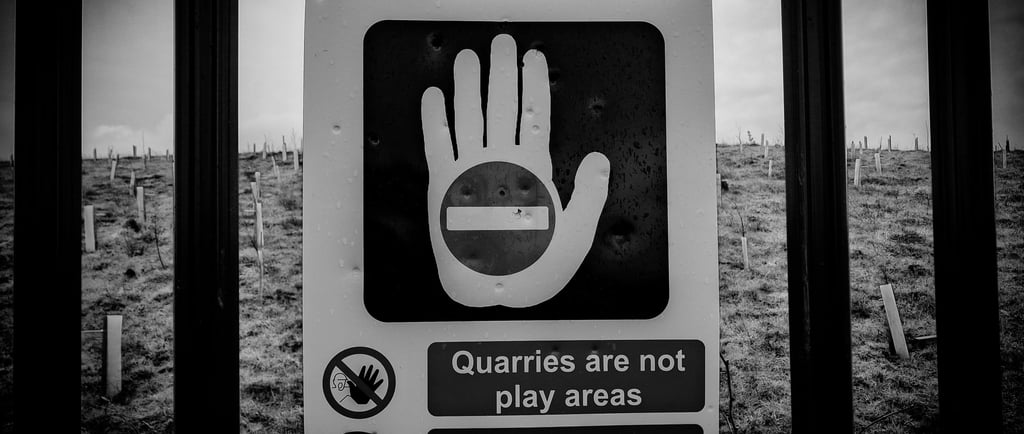

Minerals planning guidance in Wales has not been updated in over twenty years. In that time, minerals policy has become increasingly misaligned with Welsh Government priorities, statutory requirements, and contemporary environmental and social expectations. Most in the industry are apparently happy with the status quo, but those in affected communities are becoming increasingly vociferous and have claimed that Minerals Technical Advice Note 1 (Aggregates), or MTAN 1, is no longer fit for purpose (Senedd Cymru, 2025). Heledd Fychan, a Plaid MS for South Wales Central – whose constituency contains the Craig Yr Hesg Pennant sandstone quarry – stated as much in the Senedd in late 2025. This blog post, based on current research in the field, examines the strategic, policy, legislative and technical reasons why MTAN 1 requires an immediate, comprehensive review by the Senedd in Wales.
First, the background. MTAN 1 was published in 2004 (WAG, 2004), at a time when Wales did not yet have the Well-being of Future Generations Act. There were no statutory climate-change duties at that time and air quality and soundscape legislation was significantly weaker. Also, in 2004, biodiversity decline was less well understood, plus circular economy policy and the potential for recycled aggregates were at an early stage. Despite major shifts in the policy landscape over more than two decades, MTAN 1 has not been revised. As a result, local planning authorities, communities, and operators are reliant on a framework that no longer reflects national objectives, newer scientific advice, or current legal responsibilities (Senedd Cymru, 2025).
Second, there are key policy drivers of change. There is the legislative misalignment that this situation has created. Since 2004, several transformative statutes have been enacted:
1) The Well-being of Future Generations (Wales) Act (NAW, 2015) – requires public bodies to plan for long-term, preventative, integrated outcomes. MTAN 1 predates these duties entirely,
2) The Environment (Wales) Act (NAW, 2016) – mandates sustainable management of natural resources, stronger biodiversity duties, and climate responsibilities, and
3) The Environment (Air Quality and Soundscapes) (Wales) Act (Senedd Cymru, 2024) – introduces new standards for noise, dust, and air quality management. MTAN 1’s fixed buffers and mitigation advice are now outdated.
Continuing to rely on a 2004 document therefore creates significant compliance gaps and exposes planning decisions to unnecessary policy risk.
Third, the 2004 guidance provide an outdated approach to buffers, health, amenity and environmental protection. Essentially, MTAN 1 prescribes minimum buffer zones (e.g., 200m for hard rock quarries; 100m for sand and gravel). Modern evidence on PM2.5 and silica dust, low-frequency noise and vibration impacts, the potential for cumulative impact on sensitive receptors and community wellbeing and perception of risk, all suggest that such static distances are no longer adequate. A contemporary MTAN should adopt a risk-based, receptor-sensitive, and evidence-led approach, aligned with modern health and environmental standards (see, for example, Jones and BéruBé, 2011, Jones et al, 2023, Lyons et al, 2024, Thabethe et al, 2025). Just ask how important this is to residents in the deprived village of Glyncoch, near Pontypridd, for example. Some of their houses lie less than 200m from the Craig Yr Hesg Pennant sandstone quarry (ITV Wales News, 2024).
Fourth, note also that MTAN 1 does not reflect the biodiversity emergency declared in Wales, requirements for ecosystem resilience, ecological networks and corridors, and modern expectations for restoration that enhance biodiversity, carbon sequestration, and hydrological resilience. The restoration guidance in MTAN 1 is broad and largely procedural. In contrast, today’s policy requires measurable ecological outcomes, integration with nature-recovery plans, and long-term landscape stewardship (Wilker et al, 2016).
Fifth, community expectations and Welsh Government policy on public participation have evolved over the last two decades. MTAN 1 does not embed meaningful community involvement. It treats liaison committees as optional and provides no framework for transparent environmental monitoring. The guidance also does not recognise the social-justice dimension of mineral development (i.e. where disadvantaged communities disproportionately bear environmental burdens). According to community-based critics, updating the guidance would increase legitimacy, reduce conflict, and reflect contemporary commitments to community rights and equality (cf. French and Beckett, 2025).
Sixth, MTAN 1 also does not recognise some key aspects of current quarrying practice. This includes carbon budgets, embedded carbon in aggregates, the need to minimise haulage emissions, the role of recycled and secondary aggregates, the circular economy and waste-reduction priorities. There is also no recognition of the climate resilience of quarry restoration. The suggestion has been made that a renewed MTAN can help drive lower-carbon development and ensure minerals policy contributes to Wales’s net-zero trajectory.
Seventh, there is also the uncertainty of using dated guidance. Local Planning Authorities (LPAs) increasingly face planning appeals referencing an outdated MTAN. There is difficulty enforcing modern environmental standards under 2004 guidance, plus lack of clarity on how to weigh circular economy benefits as well as Inconsistent decisions across regions due to ambiguous or obsolete guidance. Instead, a modern MTAN would provide clarity, consistency and defensibility, reducing planning risk and improving confidence for operators and communities alike.
And, finally, eighth, there are also concerns about MTAN 1’s alignment with political and institutional momentum. The Welsh Government has recently introduced the Disused Tips Authority framework (NationCymru, 2026), strengthened air quality and soundscape legislation, and Increased its focus on nature recovery, well-being, and climate resilience. Minerals policy has not kept pace with this institutional evolution. Updating MTAN 1 is therefore essential, argue critics , to ensure coherence across government and to demonstrate that minerals planning supports national strategic priorities.
So what are the risks to the Welsh Government of maintaining MTAN 1 in its current form? These break down into five types of concern:
1) Legal and compliance risk: Planning decisions may be challengeable due to reliance on obsolete guidance.
2) Environmental and health risk: Outdated standards may permit developments that fall short of modern environmental protections.
3) Reputational risk: Public trust may erode if communities see mineral policy as inadequate or outdated.
4) Policy incoherence: Minerals planning will continue to lag behind Welsh Government policy on climate, biodiversity and well-being.
5) Operational risk: LPAs may continue to interpret the guidance inconsistently, undermining both certainty and fairness.
The solution would seem to lie in commissioning a full, holistic revision of MTAN 1 as a priority workstream within planning policy, with the following objectives:
1) Embed climate, biodiversity, and well-being duties
2) Establish modern, evidence-based health and environmental standards
3) Integrate circular economy principles
4) Strengthen community engagement and participation
5) Provide clarity and consistency to LPAs and operators
6) Align minerals planning with Wales’s strategic policy direction to 2050
Ultimately, a revised MTAN 1 should protect communities like those in Glyncoch and elsewhere in Wales. It can strengthen environmental outcomes, reduce risk for public bodies, and provide a more stable operational framework for industry.
References:
Ballesteros M. Řehounková K, Decleer K, Martínez-Ruiz C, Alday JG, Gentili R. Nunes A. Salgueiro PA. Mahy G. Bouchoms S. and Kirmer A. (2025). Maximising biodiversity potential in Europe’s mines and quarries: A key role for EU Nature Restoration Regulation targets. Ambio, 55, 280–296, https://doi.org/10.1007/s13280-025-02235-4
French G, and Beckett L. (2025). From poverty to possibility: critical ethnography and community solutions in Wales. Ethnography and Education, 1–13. https://doi.org/10.1080/17457823.2025.2591766
ITV Wales News (2024), Glyncoch residents 'heartbroken' and 'angry' as Craig y Hesg quarry expansion approved, https://www.itv.com/news/wales/2024-08-14/residents-heartbroken-and-angry-as-quarry-expansion-approved (last accessed 22.3.26)
Jones, T. and BéruBé, K., (2011). The bioreactivity of the sub-10 μm component of volcanic ash: Soufrière Hills volcano, Montserrat. Journal of Hazardous Materials, 194, pp.128-134 https://doi.org/10.1016/j.jhazmat.2011.07.092
Jones JS, Nedkoff L, Heyworth JS, Almeida OP, Flicker L, Golledge J, Hankey GJ, Lim EH, Nieuwenhuijsen M, Yeap BB, and Trevenen ML (2023), Long-term exposure to low-concentration PM2.5 and heart disease in older men in Perth, Australia: The Health in Men Study. Environmental Epidemiology 7(4), p e255, https://doi.org/10.1097/EE9.0000000000000255
Lyons, S., Nolan, A., Carthy, P. et al. (2024), Long-term exposure to PM2.5 air pollution and mental health: a retrospective cohort study in Ireland. Environmental Health, 23, 54 (2024). https://doi.org/10.1186/s12940-024-01093-z
NationCymru (2026), Welsh and UK Governments reaffirm joint commitment to coal tip safety, https://nation.cymru/news/welsh-and-uk-governments-reaffirm-joint-commitment-to-coal-tip-safety/ (last accessed 22.3.26)
National Assembly for Wales (2015), Well-being of Future Generations (Wales) Act, Cardiff: NAW, https://www.legislation.gov.uk/anaw/2015/2/contents
National Assembly for Wales (2016), Environment Wales Act, Cardiff: NAW, https://www.legislation.gov.uk/anaw/2016/3/contents
Senedd Cymru / Welsh Parliament (2024), Environment (Air Quality and Soundscapes) (Wales) Act, Cardiff: SC, https://www.legislation.gov.uk/asc/2024/2/contents
Senedd Cymru / Welsh Parliament (2025), Plenary Question from Heledd Fychan MS for South Wales Central Region to Rebecca Evans MS, Cabinet Secretary for Economy, Energy and Planning, https://record.senedd.wales/Plenary/15433?lang=en-GB
Thabethe NDL, Makonese T, Masekameni D and Brouwer D (2025) Probabilistic human health risk assessment of PM2.5 exposure in communities affected by local sources and gold mine tailings. Frontiers in Public Health 13:1515009. http://doi.org/10.3389/fpubh.2025.1515009
Welsh Assembly Government (2004), Guidance - Minerals technical advice note (MTAN) Wales 1: aggregates, Cardiff: Planning Division, https://www.gov.wales/minerals-technical-advice-note-mtan-wales-1-aggregates (last access 21.3.26)
Wilker J, Rusche K, Benning A, MacDonald MA, Blaen, P (2016), Applying ecosystem benefit valuation to inform quarry restoration planning, Ecosystem Services, 20, 44-55, https://doi.org/10.1016/j.ecoser.2016.06.003
© 2026 Nick Hacking